

Enterprise architecture used to be defined by multi-year roadmaps, rigid on-premises infrastructure, and monolithic application design. In today's dynamic business environment, that paradigm has collapsed. Modern enterprise architecture (Modern EA) has evolved from an administrative governance model into an active, continuous engine for business agility. To stay competitive, organizations are shifting away from static IT blueprints toward flexible, cloud-native frameworks engineered for real-time data streaming, modular service delivery, and native artificial intelligence integration.
Modern enterprise architecture is an adaptive, domain-driven framework that aligns business strategy with modular technology ecosystems. Unlike legacy enterprise architecture, which prioritized static documentation and centralized control, modern EA prioritizes composability, continuous deployment, decoupled systems, and autonomous team execution.
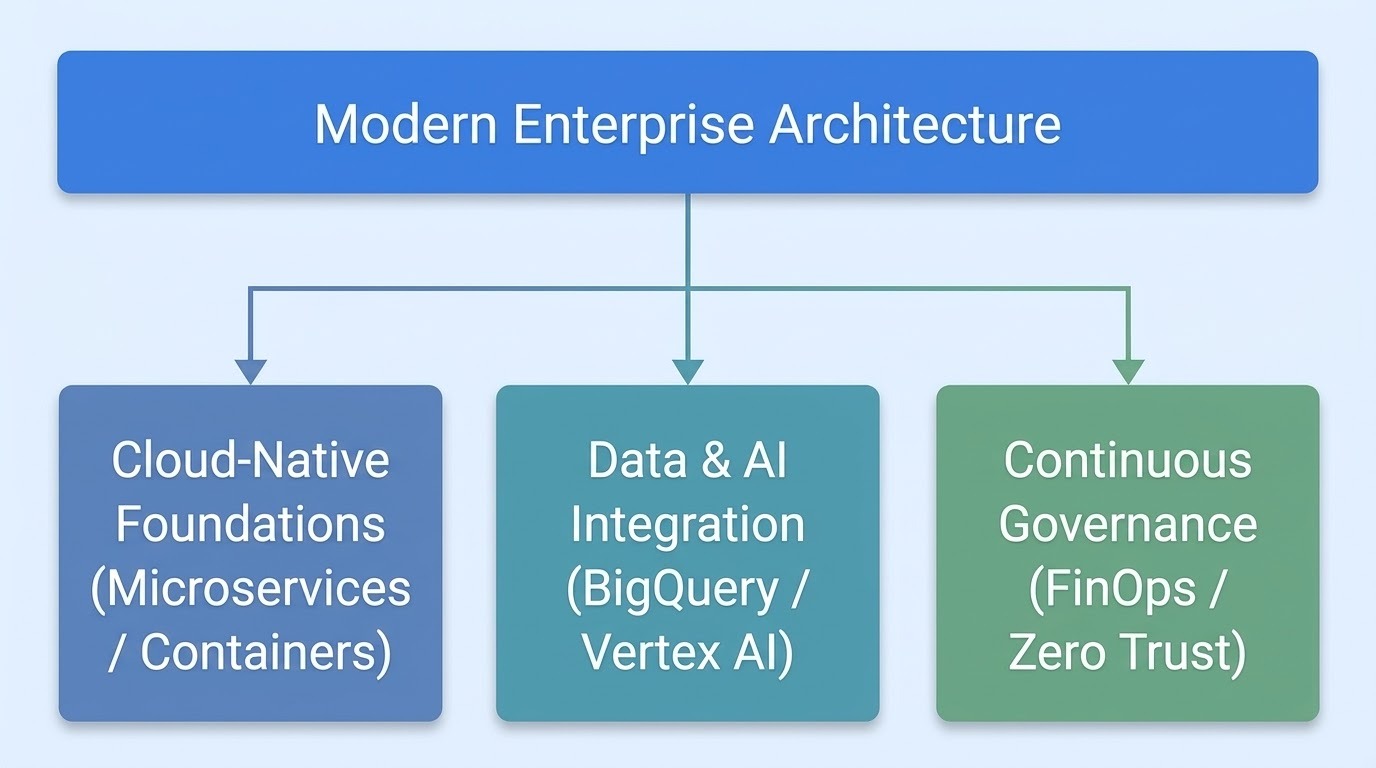
Cloud-native architecture forms the structural backbone of modern EA. By building applications specifically to leverage the elasticity and distribution of the cloud, enterprises eliminate single points of failure and unlock unprecedented operational speed.
Legacy systems require provisioning for peak capacity, resulting in idle compute resources for most of the year. Cloud-native architectures leverage container orchestration and serverless computing to scale resources up or down dynamically based on live workload demands. Integrated with FinOps principles, this ensures that compute costs track revenue-generating business activity rather than static infrastructure overhead.
Decoupling applications into microservices connected by standardized APIs allows cross-functional teams to build, deploy, and iterate independently. When one service requires an update or experiences a failure, the rest of the enterprise ecosystem continues operating without downtime.
Modern EA eliminates catastrophic system failures through automated health checks, declarative container orchestration, and multi-region redundancy. Applications self-heal automatically: unhealthy instances restart, traffic reroutes around failed zones, and workloads rebalance without manual operator intervention.
While multicloud design is a frequent conversation in modern EA, architectural execution demands a unified ecosystem capable of handling high-throughput data processing and cognitive workloads. Google Cloud stands out as the definitive platform for modern EA because it was engineered from its inception around distributed, containerized systems and deep-learning infrastructure.
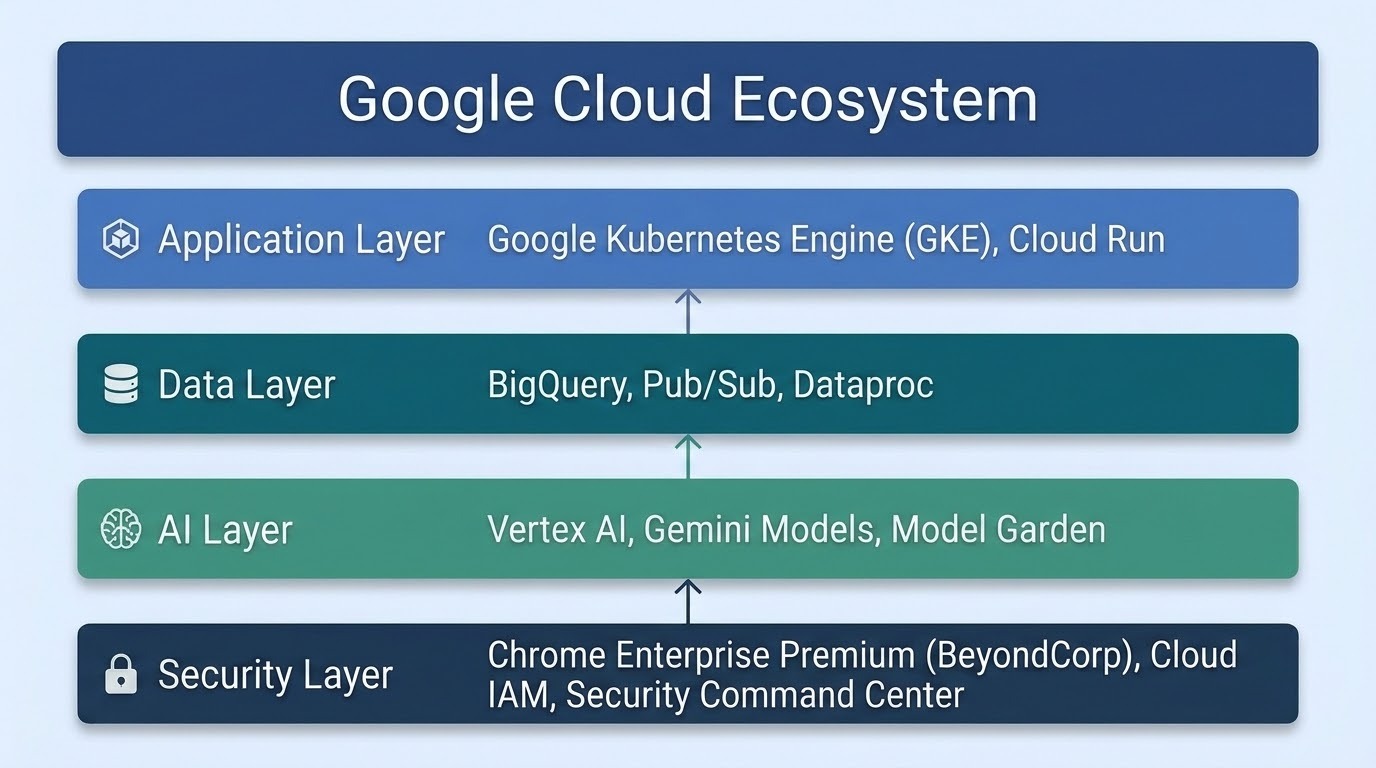
Google invented Kubernetes, and Google Kubernetes Engine (GKE) remains the industry benchmark for enterprise container operations. GKE Autopilot simplifies modern EA by automating cluster infrastructure management, provisioning nodes according to workload specifications, and applying proactive security hardening out of the box.
Modern EA collapses the barrier between transactional processing and analytical intelligence. Google Cloud’s BigQuery serves as a serverless, highly scalable data foundation capable of running real-time analytics across petabytes of operational data. Because it natively integrates with AI frameworks (BigQuery ML and Vertex AI), BigQuery enables architects to query structured data alongside generative AI models directly through standard SQL queries.
Artificial intelligence is no longer an experimental feature; it is an architectural requirement. Modern EA requires an infrastructure that can ground large language models (LLMs) in proprietary company data securely and at scale.
Modern EA assumes that network perimeters are permeable. Google Cloud’s Chrome Enterprise Premium (formerly BeyondCorp Enterprise) and Identity-Aware Proxy (IAP) implement Zero Trust architecture natively, shifting access control from the network perimeter to individual users and devices. Security policies are verified at every request, ensuring secure operational access across hybrid workforces and decentralized systems.
Transitioning from technical debt to modern EA requires a phased, business-aligned roadmap rather than an unguided lift-and-shift:
Building a modern enterprise architecture requires deep domain expertise across legacy migration, Zero Trust identity architecture, data warehousing, regulatory compliance (HIPAA, SOC 2, ISO 27001), and FinOps governance. Attempting to navigate this transformation without specialized architectural guidance often leads to fragmented microservices, security misconfigurations, runaway cloud spend, and stalled deployment schedules.
As a certified Google Cloud Premier Partner, Cloudasta specializes in guiding organizations through end-to-end cloud and AI transformation with our GCP Migration & Cost Optimization services.
👉 Contact Cloudasta Today to Schedule Your GCP Assessment
Legacy enterprise architecture focuses on rigid, centralized governance, static documentation, and long delivery cycles for on-premises systems. Modern enterprise architecture focuses on decentralized execution, composable microservices, automated CI/CD, cloud-native scalability, and rapid adaptation to market conditions.
Cloud-native architecture provides the elasticity, resilience, and modularity that modern EA demands. By leveraging containers, microservices, and serverless compute, organizations eliminate single points of failure, accelerate release velocity, and scale operational infrastructure dynamically.
Google Cloud integrates AI directly into its platform architecture through Vertex AI and the Gemini model family. It allows organizations to build, tune, and deploy enterprise-grade AI models on top of a unified BigQuery data layer, supported by strict enterprise data privacy guarantees and Zero Trust security controls.
Organizations should begin by assessing current architectural technical debt, decoupling monolithic applications into modular services using API wrappers, and establishing an intelligent cloud data foundation in BigQuery. Engaging an experienced Google Cloud Premier Partner like Cloudasta helps de-risk migration, enforce FinOps and compliance guardrails, and accelerate time-to-value.


