The Firebase-GCP Connection: Leveraging Cloud Power for Mobile Apps
How Do Firebase and Google Cloud Platform (GCP) Work Together?
Quick Answer (TL;DR): Firebase and Google Cloud (formerly Google Cloud Platform / GCP) are not competing platforms, Firebase is the developer-facing abstraction layer built directly on top of Google Cloud’s enterprise infrastructure. When you create a Firebase project, you are creating an underlying Google Cloud project with the exact same Project ID, shared billing account, and identity boundaries. While Firebase offers client-centric SDKs, real-time databases, and instant mobile-first primitives (Authentication, Push Notifications, Crashlytics), Google Cloud unlocks enterprise-scale infrastructure (BigQuery analytics, Gemini Enterprise Agent Platform foundational models, VPC Service Controls, Pub/Sub event streaming, and custom container orchestration via Cloud Run). By leveraging the Firebase-GCP connection, engineering teams can build and prototype at startup speed using Firebase, then scale without rewrites into Google Cloud's enterprise ecosystem.
Executive Summary / Quick Takeaways
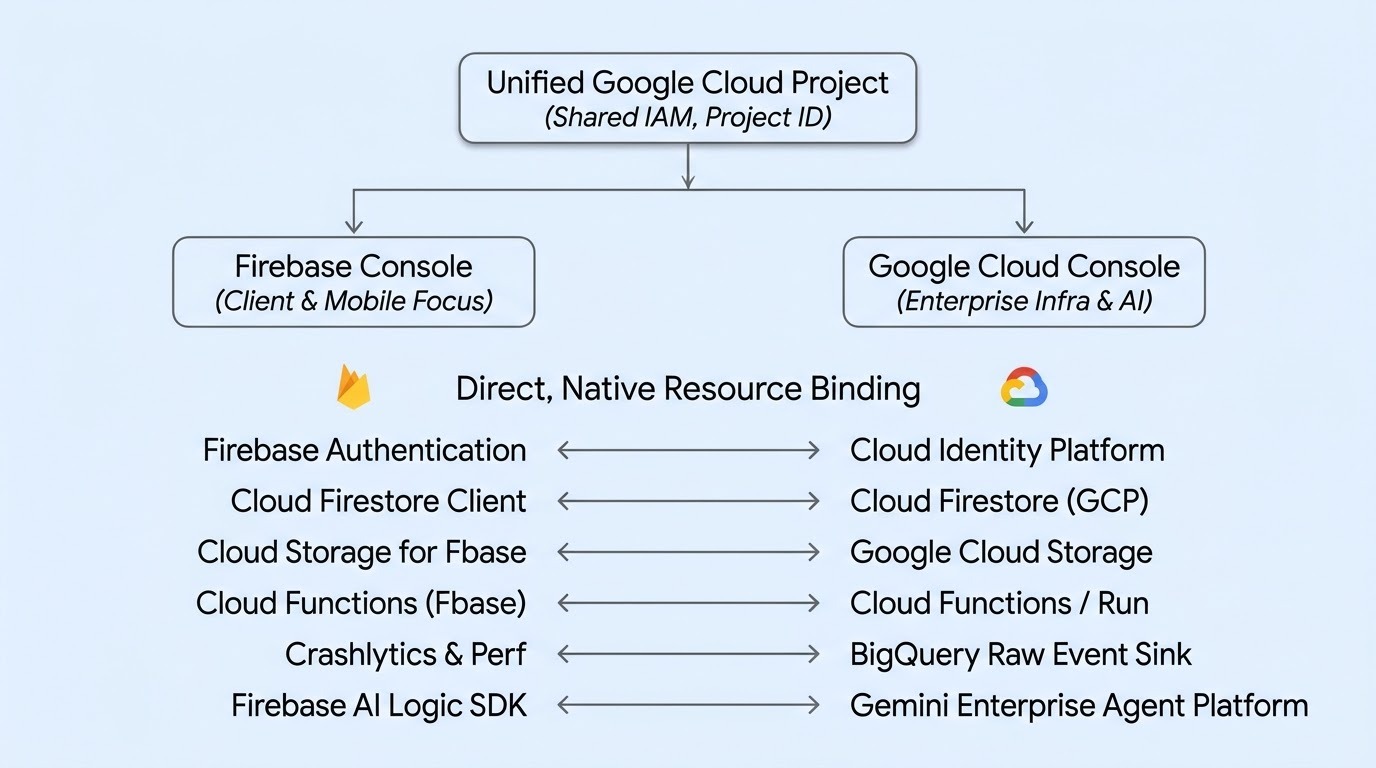
Single Unified Project Architecture: Every Firebase project is a Google Cloud project under the hood, sharing the exact same Project ID, IAM security boundaries, and Cloud Billing account with zero data replication or translation proxies.
Client Velocity Meets Enterprise Governance: Frontend and mobile teams can ship rapidly with opinionated Firebase SDKs (Auth, Firestore, FCM, Firebase AI Logic), while Cloud Architects and SecOps enforce enterprise controls via Cloud IAM, VPC Service Controls (VPC-SC), and Customer-Managed Encryption Keys (CMEK).
Zero-ETL Analytics & Enterprise AI: Stream mobile telemetry directly from Firebase Analytics and Crashlytics into BigQuery for cross-enterprise SQL joins, and connect client apps securely to Gemini 2.5 models via Firebase AI Logic and the Gemini Enterprise Agent Platform.
Predictable FinOps Transitions: Upgrading from the free Firebase Spark Plan to the pay-as-you-go Blaze Plan preserves generous daily and monthly free-tier allowances before metered Google Cloud base rates apply on a single consolidated invoice.
Dimension
Firebase
Google Cloud (GCP)
The Combined Power (Firebase + GCP)
Primary Audience
Mobile & Web Developers, Frontend Engineers
Cloud Architects, Data Engineers, DevOps, SecOps
Full-stack agility: Client teams build fast; Cloud teams enforce governance
Interface & DX
Opinionated, client-side SDKs, intuitive console
Granular infrastructure console, CLI, Terraform, IAM
Rapid app prototyping backed by infrastructure-as-code
Front-facing mobile app tied directly to enterprise data & AI backends
Data & Storage
Realtime Database, Firestore, Cloud Storage SDKs
Cloud Storage Buckets, AlloyDB, Spanner, BigQuery
Real-time user sync on the device + zero-ETL petabyte analytics in Google Cloud
Billing Model
Free Spark Plan or pay-as-you-go Blaze Plan
Granular per-second / per-byte resource metering
Unified single bill under one Google Cloud Billing Account
1. Architectural Reality: Deconstructing the "Under-the-Hood" Integration
The most fundamental concept enterprise architects must understand is that every Firebase project is intrinsically a Google Cloud project. There is no data replication, translation proxy, or external sync mechanism between the two environments. They are two different control planes managing the exact same underlying cloud resources.
The Shared Resource Matrix
Identity & Auth: Firebase Authentication runs directly on top of Google Cloud Identity Platform. If your mobile app outgrows standard social logins and requires SAML/OIDC enterprise Single Sign-On (SSO), multi-tenancy, SLA guarantees, or SMS fraud protection, you can upgrade in-place via Google Cloud without altering a single line of your mobile client authentication code.
Cloud Firestore: A serverless, document-oriented NoSQL database that can be accessed from Firebase client SDKs with real-time listeners and offline support, or queried via Google Cloud server-side libraries with granular IAM roles, automated backups, Point-in-Time Recovery (PITR), and multi-region disaster recovery.
Cloud Storage for Firebase: Files uploaded by mobile users through the Cloud Storage for Firebase SDK land directly inside standard Google Cloud Storage (GCS) buckets. Server-side microservices on Google Cloud (such as media transcoders or ML pipelines) can access those exact objects instantaneously with zero data-transfer overhead.
Cloud Functions for Firebase: A developer-friendly wrapper over Cloud Run functions (formerly Cloud Functions 2nd gen), which packages event-driven backend code directly into containerized workloads executing on Cloud Run.
Architecture Mapping: Firebase Control Plane vs. Google Cloud Control Plane
Firebase Console (Client & Mobile Focus)
Binding Type
Google Cloud Console (Enterprise Infra & AI)
Firebase Authentication
Direct, Native Resource Binding
Google Cloud Identity Platform
Cloud Firestore Client SDKs
Direct, Native Resource Binding
Cloud Firestore (Server-Side / IAM)
Cloud Storage for Firebase
Direct, Native Resource Binding
Google Cloud Storage (GCS)
Cloud Functions for Firebase (2nd gen)
Direct, Native Resource Binding
Cloud Run functions / Cloud Run
Firebase Crashlytics & Performance Monitoring
Direct, Native Resource Binding
BigQuery Raw Event Sink
Firebase AI Logic SDK
Direct, Native Resource Binding
Gemini Enterprise Agent Platform
2. Top Architectural Patterns: Supercharging Mobile Apps with GCP
Mobile engineering teams commonly encounter architectural limitations when relying solely on standalone mobile Backend-as-a-Service (BaaS) tools. The Firebase-GCP synergy solves this by bridging the gap between client simplicity and deep enterprise infrastructure.
Pattern A: Modern Generative AI with Firebase AI Logic
The Challenge: Calling Large Language Models (LLMs) directly from a mobile device risks exposing private API keys in client binaries or requires building, securing, and scaling an intermediate backend proxy just to relay prompts.
The Firebase-GCP Solution: The Firebase AI Logic SDK (formerly Vertex AI in Firebase) connects mobile and web client code directly to Google Cloud's foundational models, such as Gemini 2.5 Flash and Gemini 2.5 Pro via the Gemini Enterprise Agent Platform. Security is enforced at the edge via Firebase App Check and client device attestation, preventing unauthorized API abuse without requiring teams to maintain custom proxy servers on Google Cloud.
Pattern B: Zero-ETL Mobile Data Warehousing with BigQuery
The Challenge: Firebase Crashlytics, Performance Monitoring, and Google Analytics for Firebase provide excellent out-of-the-box dashboards, but cannot perform cross-table SQL joins against enterprise ERP orders, CRM leads, or inventory databases.
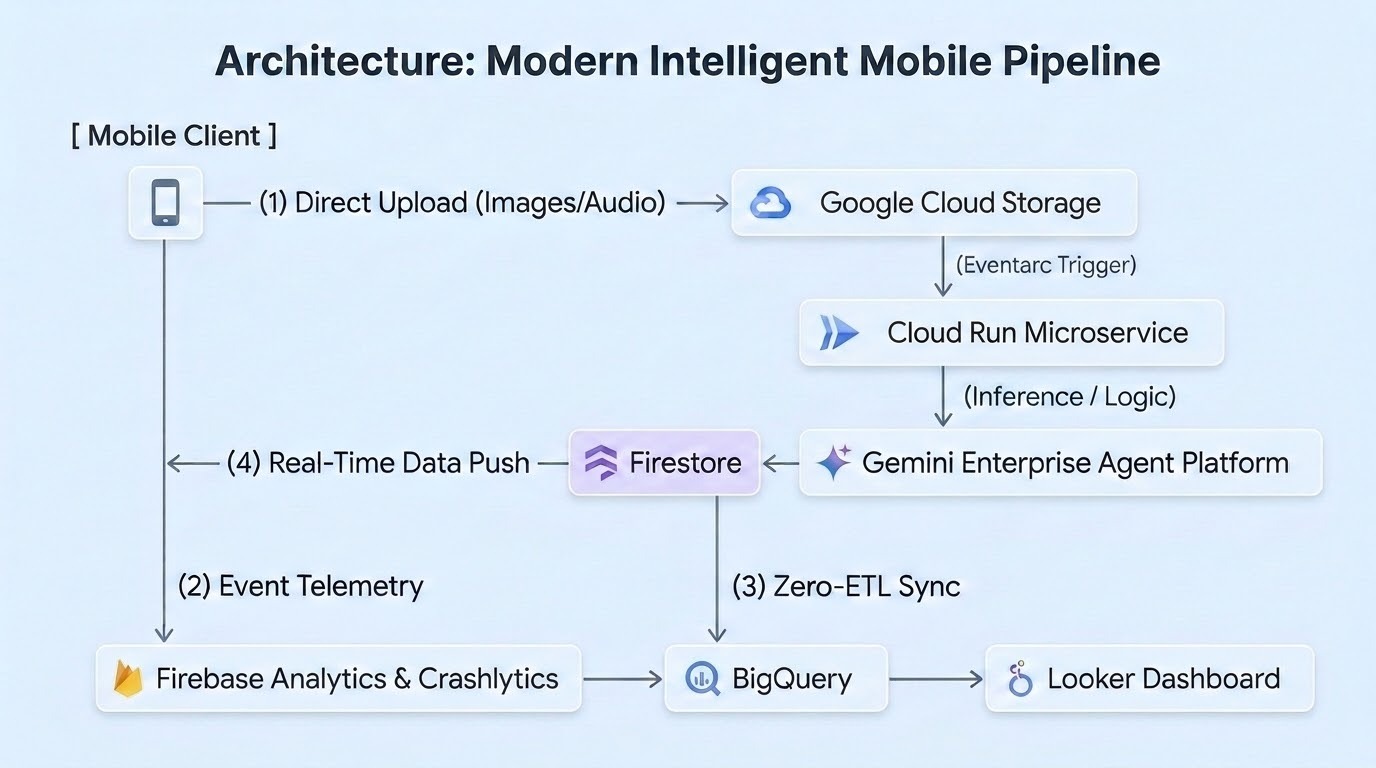
The Firebase-GCP Solution: Firebase features native, one-click streaming exports to BigQuery. Every app session, user interaction, network latency metric, and crash stack trace streams continuously into partitioned BigQuery tables. Data engineering teams can join real-time mobile telemetry with production AlloyDB, Cloud SQL, or SAP datasets, then visualize end-to-end user journeys in Looker or Looker Studio.
Pattern C: High-Throughput Asynchronous Processing via Cloud Pub/Sub
The Challenge: Mobile apps triggering compute-heavy backend tasks (video rendering, document OCR parsing, or push notification broadcasts to millions of devices) can easily overwhelm synchronous HTTP endpoints or hit function execution timeouts.
The Firebase-GCP Solution: Mobile clients write a lightweight status record to Firestore or upload a media asset to Cloud Storage. This immediately emits an event to Google Cloud Pub/Sub via Eventarc. Downstream containerized microservices running on Cloud Run or Google Kubernetes Engine (GKE) consume the queue asynchronously at scale, running inference via the Gemini Enterprise Agent Platform and updating the Firestore document upon completion to notify the mobile user in real time.
3. Security, Compliance, and Enterprise Governance
While early-stage startups often rely solely on client-facing Firebase Security Rules, mature organizations require defense-in-depth governance to satisfy SOC 2, HIPAA, PCI-DSS, and ISO 27001 compliance frameworks. Bridging Firebase into Google Cloud unlocks enterprise-grade security controls.
Firebase App Check verifies that incoming API traffic originates from your authentic, untampered mobile application binary (using Apple App Attest / DeviceCheck on iOS and Google Play Integrity API on Android) or verified web domain (via reCAPTCHA Enterprise) rather than automated bots, scripts, or rooted emulator farms. Requests lacking valid attestation tokens are blocked at the edge before incurring compute, AI token, or database read costs.
2. Defense-in-Depth: Combining Security Rules with Google Cloud IAM
Firebase Security Rules govern fine-grained, document-level access for untrusted mobile and web clients (for example, verifying request.auth.uid == resource.data.ownerId before returning a record).
Google Cloud IAM governs infrastructure-level access for trusted backend services, CI/CD pipelines, and data engineers (for example, granting a Cloud Run microservice least-privilege roles/datastore.viewer or read-only access to specific Cloud Storage buckets).
3. Enterprise Data Protection: VPC Service Controls (VPC-SC) and CMEK
When your mobile backend processes regulated data, such as Protected Health Information (PHI) or financial transactions, you can place the underlying Google Cloud project inside a VPC Service Controls (VPC-SC) perimeter. This establishes a cryptographic boundary around Cloud Firestore, Cloud Storage, and BigQuery APIs to prevent data exfiltration, and can be paired with Customer-Managed Encryption Keys (CMEK) via Cloud KMS for full control over data encryption at rest.
4. Financial Optimization: Managing Costs Across Firebase and GCP
One of the most frequent FinOps and procurement questions is how billing operates when spanning the Firebase and Google Cloud consoles. Projects typically begin on the Firebase Spark Plan, a zero-cost development tier with strict quota caps that requires no credit card. Moving to production or enabling Google Cloud integrations requires upgrading to the Firebase Blaze Plan, which transitions the project to a pay-as-you-go model tied directly to a Google Cloud Billing Account.
Under the Blaze Plan, costs are structured across three transparent layers:
Firebase No-Cost Tier Allowances Apply First: Upgrading to the Blaze Plan does not forfeit your free usage tiers. Generous no-cost allowances remain in effect, including 50,000 daily document reads, 20,000 daily writes, 20,000 daily deletes, and 1 GiB of total stored data in Cloud Firestore, before billable meters begin.
Metered Overages at Google Cloud Base Rates: Any Firebase resource consumption exceeding the no-cost tier limits (such as additional Firestore document operations or Cloud Storage egress) is billed automatically at standard Google Cloud published rates.
Unified Billing for Native GCP Workloads: Any auxiliary Google Cloud services utilized alongside Firebase, including BigQuery slot consumption, Cloud Run vCPU/memory, and Gemini Enterprise Agent Platform token usage, are billed on the exact same consolidated Google Cloud invoice and qualify toward enterprise Committed Use Discounts (CUDs).
Key FinOps & Cost-Control Best Practices
Eliminate Unintended Document Read Spikes: Poorly constructed mobile real-time listeners can inadvertently trigger millions of duplicate Firestore reads. Use Firestore Data Bundles to package and cache static or semi-static query results (such as product catalogs or featured articles) on Cloud Storage backed by Cloud CDN, slashing database read costs by up to 70%.
Enforce App Check to Prevent Denial-of-Wallet Attacks: Malicious actors scraping client endpoints or spamming generative AI features can drive massive overages. Enforcing Firebase App Check across Firestore, Cloud Storage, Cloud Functions, and Firebase AI Logic ensures you only pay for legitimate user traffic.
Partition and Cluster BigQuery Event Tables: Streaming millions of raw Firebase Analytics and Crashlytics events into BigQuery can become costly if analysts execute unoptimized SELECT * queries. Configure date-based table partitioning and cluster by event_name or user_pseudo_id to drastically reduce scanned bytes.
Configure Automated Google Cloud Budget Alerts: Set granular budget thresholds inside the Google Cloud Billing Console wired to Cloud Pub/Sub topics. Use these programmatic alerts to notify FinOps teams in Slack or automatically throttle non-critical background jobs if daily spend deviates from baseline.
5. Comparison Guide: When to Use Firebase vs. Native GCP
Choosing the right control plane for each workload component ensures maximum mobile development velocity without sacrificing backend scalability:
Scenario / Workload
Optimal Path
Architectural Rationale
Mobile Push Notifications
Firebase (FCM)
Firebase Cloud Messaging natively manages Apple Push Notification service (APNs) and Android device tokens, background routing, and topic subscriptions with zero server configuration.
Complex Relational Queries & ACID Joins
Google Cloud (Cloud SQL / AlloyDB)
Firestore excels at hierarchical document lookups and real-time sync; complex multi-table SQL joins and ledger transactions belong in Cloud SQL or AlloyDB accessed via Cloud Run microservices.
Client-Side Document Sync & Offline Mode
Firebase (Cloud Firestore)
Native local device caching, optimistic UI latency compensation, and automatic offline-to-online delta synchronization are built directly into the Firebase client SDKs.
Large-Scale Asynchronous Batch Jobs
Google Cloud (Cloud Run Jobs / Workflows)
Event-driven Cloud Functions for Firebase time out after 9 minutes (HTTP) or up to 60 minutes (2nd gen HTTP). Long-running batch processing belongs in Cloud Run Jobs or Google Cloud Workflows.
Mobile Client Generative AI
Firebase (Firebase AI Logic)
Enables mobile and web developers to generate text, analyze multimodal inputs, and run multi-turn chats with Gemini models securely from client SDKs using App Check attestation.
Custom Model Training & Agent Orchestration
Google Cloud (Gemini Enterprise Agent Platform)
Full enterprise AI/ML lifecycle for multi-agent orchestration, enterprise grounding, custom model fine-tuning, evaluation pipelines, and governance.
6. The Firebase-GCP Challenge: Why Partner with an Expert?
While creating a Firebase project takes less than sixty seconds, scaling a rapidly growing mobile application into an enterprise-grade Google Cloud environment introduces complex architectural and financial hurdles. Organizations frequently encounter runaway Firestore read bills caused by unoptimized client listeners, compliance bottlenecks when preparing for HIPAA or SOC 2 audits, or fragmented identity architectures between legacy enterprise directories and mobile apps.
How Cloudasta Accelerates Your Mobile Cloud Infrastructure
As a Premier Google Cloud Partner, Cloudasta helps engineering, SecOps, and FinOps leaders optimize costs and data migration processes. Ready to scale and secure your mobile cloud architecture? Contact Cloudasta today for an expert cost assessment.
Frequently Asked Questions (FAQ)
Is Firebase being replaced by Google Cloud?
No. Google actively invests in Firebase as its premier mobile and web application development platform, while Google Cloud serves as the underlying enterprise infrastructure foundation. Google continues to deepen the native integration between the two, as demonstrated by Firebase AI Logic, Firebase Data Connect (backed by Cloud SQL for PostgreSQL), and 2nd gen Cloud Functions powered by Cloud Run.
Can I connect an existing Google Cloud project to Firebase?
Yes. In the Firebase Console, click Add project and select your existing Google Cloud project from the dropdown menu. This attaches Firebase APIs and client control planes directly to your existing GCP project without migrating resources or changing your Project ID.
Do Firebase Authentication and Google Cloud Identity Platform share user databases?
Yes. When you upgrade to Google Cloud Identity Platform in the Google Cloud Console, your existing Firebase Authentication user pool is upgraded automatically in place. You immediately gain enterprise capabilities, such as Multi-Factor Authentication (MFA), SAML/OIDC SSO, and activity logging, without forcing users to reset passwords or changing client SDK code.
Can I access Cloud Firestore directly from Google Cloud services without using Firebase SDKs?
Yes. Google Cloud provides official server-side client libraries for Go, Python, Java, Node.js, C#, PHP, and Ruby. These backend libraries interact directly with your Firestore database using standard Google Cloud IAM service accounts, bypassing client-side Firebase Security Rules for trusted server operations.
How do I secure Google Cloud APIs called from a mobile app?
Combine Firebase App Check with Firebase Authentication. App Check attests that incoming traffic originates from an authentic, untampered mobile app binary, while Firebase Authentication verifies the identity of the end user. For custom backend microservices running on Cloud Run or GKE, place API Gateway or Cloud Endpoints in front of your services to validate signed Firebase JWT tokens at the edge.
Cloudasta, Google Workspace Productivity & Migration Experts
Your one-stop partner for seamless migrations, expert advisory, support, and training.